
The Black Belt Isn't the Point: What Kids Really Learn From Karate
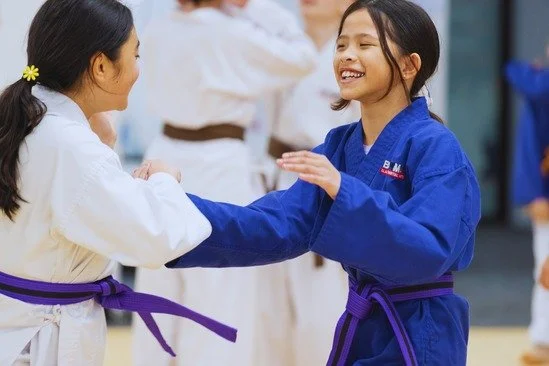
Confident, happy students at BBMA Hornsby
Parents bring their children to Karate for all sorts of reasons. We meet parents who want their child to become more confident, improve their focus or learn some self-defence. Some are looking for a physical activity their child will actually enjoy. Others have a child who is shy, struggling socially or hasn't found their place in team sports.
The kids have their own reasons. They want to learn to kick. They want to spar. They want to break a board. They watched someone doing Karate and thought it looked cool! These are all perfectly good reasons to start :) Over time, though, we tend to see changes that have very little to do with how high a child can kick.
Confidence takes practice
Parents often tell us they'd like their child to be more confident. Confidence is difficult to teach directly because children need experiences that give them reasons to believe in themselves.
BBMA Kids’ Karate programs provide plenty of those experiences.
A child who was nervous about joining their first class manages to walk onto the mat. A few weeks later, they're training without looking over to Mum or Dad every few minutes. They learn a technique they couldn't do when they started. They put their hand up to demonstrate something. Eventually, they might perform a kata in front of an assessor, or even compete in their first tournament.
None of these moments needs to be particularly big. Confidence is a skill which can be built. The accumulation of experiences (designed to build confidence) matters.
Children gradually build a history of doing things they once found difficult. The next time they're faced with something unfamiliar, they have previous experience to draw on. BBMA kids know they can do hard things, and are not afraid to give something new a try
They get things wrong. Regularly.
There is plenty of failure in Karate.
Students forget their kata. They put the wrong foot forward. They lose their balance halfway through a kick. They misunderstand an instruction. They struggle with something that another student seems to pick up immediately.
Sometimes they don't meet the standard they're working towards.
Our students aren't expected to enjoy every disappointment. Disappointment is human and to be expected. We do expect students to learn how to respond constructively to disappointment - with a ‘growth’ mindset.
They listen to the feedback, work out what needs more attention and practise it. Sometimes they'll fix it quickly. Sometimes they'll be working on the same problem for weeks.
Being able to stay with something when you're not immediately good at it is an incredibly useful life skill - something students will benefit from well beyond the dojo.
What we mean by discipline
Martial arts has a reputation for discipline, which can conjure up images of very stern instructors and rows of children standing silently at attention.
That's not really how we think about it. For us, discipline is much more ordinary. It's arriving on time and eady to train. Listening when someone else is speaking. Practising the technique you find difficult instead of always choosing the one you're good at. Controlling your body when you're excited. Being kind to yourself and others. Looking after your training partner. Continuing to work towards something even when the initial enthusiasm has worn off.
Students also learn that progress has to be earned. Belt Promotion requires attendance, skill development, knowledge, attitude and readiness. Desperately wanting the next belt isn't enough.
Feeling nervous is normal
First classes can be nerve-racking. So can performing a kata, demonstrating a self-defence skill, attempting a board break or being assessed for Belt Promotion.
We don't expect those nerves to disappear. A student can be nervous and still walk onto the mat. They can forget part of their kata, collect themselves and then continue. They can be apprehensive about training with a new partner and train safely and respectfully anyway.
The experience becomes familiar with repetition. The child who once needed a parent standing beside the mat may eventually be the student volunteering to demonstrate in front of everyone else.
Respect has to work when things aren't going your way
Traditional Shotokan Karate has plenty of formal etiquette. Our dojo is a quiet, respectful space. We bow when entering and leaving the dojo. Students bow to instructors and training partners. We have clear expectations about behaviour on the mat.
The harder lessons usually happen away from the more ‘obvious’ formalities…
Can you control your technique when you're working with someone smaller or less experienced than you?
Can you listen to a correction without becoming defensive?
Can you lose a point in a sparring match without making excuses?
Can you win one without showing off?
Can you show kindness and respect to others when you’re upset or frustrated?
Can you work patiently with a beginner when you'd rather train with someone at your own level?
BBMA Students get opportunities to practise these behaviours every week.
Big goals take a long time
A brand-new white belt can look at a black belt performing a kata and have absolutely no idea how they'll ever be able to do it. That’s OK because we don't expect them to :) They have something much smaller to work on first.
Learn the basics. Come to class. Keep coming. Aim to improve your technique a little at a time. Earn the next stripe. Prepare for Belt Promotion. Move to the next level and begin again. Don’t give up!
A black belt can be built from years of ordinary, sincere, consistent training.
For children growing up with instant entertainment, instant answers and games designed around constant rewards, there's great value in having something in their life that simply can't be rushed.
Kids need somewhere to move
Karate is also exercise, although most children aren't thinking about it that way while they're training.
They're kicking pads, punching, jumping, balancing, reacting, stretching, moving with a partner and learning to coordinate their hands and feet. They're developing strength, fitness, balance and body awareness while concentrating on the activity in front of them.
We'd much rather have a child leave class sweaty and smiling than spend half an hour explaining to them why exercise is important.
The dojo becomes a social place too
Our students come from lots of different schools and backgrounds. Some arrive with friends, but most do not.
Training gives them an immediate shared activity. They hold pads for each other, practise together and help each other learn. Older and more experienced students often become role models for younger students.
Not every child enjoys traditional team sports, and not every child finds making friends easy. The structure of a martial arts class can make social interaction a little less complicated because there's always something to do together.
Over time, we see friendships form between children who probably wouldn't otherwise have met.
And eventually, many of them earn a black belt
We make a big deal of black belts at BBMA. They take years to earn and we want students to be proud when they reach that standard
By then, we've known the student and their family for a long time. We've seen the classes where everything clicked and the classes where nothing did. We've watched them prepare for Belt Promotions, forget things they definitely knew, get frustrated, improve, grow, help younger students and become increasingly confident and independent in their training.
The physical skills are obvious because you can see them. The other changes can be quieter. We love to see kids become more comfortable speaking to adults. Kids who recover from mistakes more quickly.
Eventually ,our shy and nervous kids don't need Mum or Dad beside the mat anymore. They help the nervous new student because they remember being that student themselves. They confidently demonstrate at the front of class (and love doing it!). And they understand that being good at something worthwhile takes work.
The belt records their progress in Karate. They take everything else home with them - helping them succeed at home, with friends, at school and in every other area of their lives.
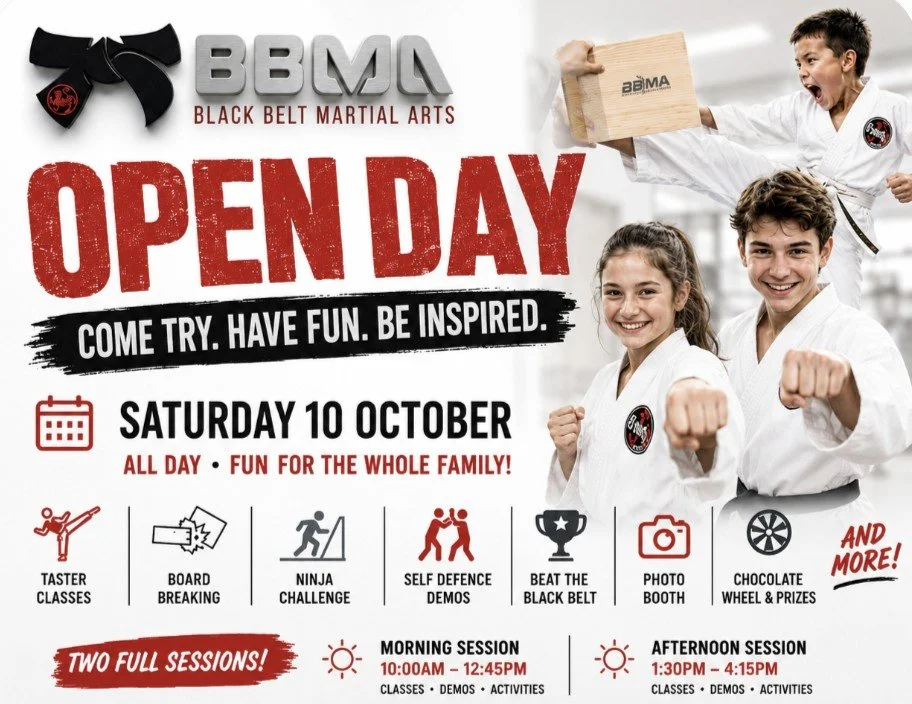
Come and train with us at our Open Day
We're opening BBMA Hornsby on Saturday 10 October for our 2026 Open Day, and local families are welcome to come and see what training with us is actually like.
We'll have activities running throughout the day, including:
Traditional Shotokan Karate taster classes
Little Dragons classes for younger children
Padwork and sparring drills
Self-defence
Kata
Board breaking
Nunchaku activities
Beat the Black Belt challenges
Demonstrations, games and activities around the dojo
There are sessions for children, teenagers and adults. No martial arts experience is needed.
BBMA Hornsby Open Day
Saturday 10 October 2026
Suite 8, 6-18 Bridge Road Hornsby
Find out More!
Phone: 0494 643 050
Email: service@bbmahornsby.com.au
